Plumbing can be overwhelming for homeowners because they don’t understand how it works. In this post, I’m going to walk you through the main components of a home’s plumbing system, what they each do, how they work, and what the homeowner should know about them. At Precision Plumbing, we want to help homeowners in Eugene and Springfield understand their homes, so they can be empowered to make the right choices for them. Here is a list of eight components of the home’s plumbing system: the water meter, water service, pressure reducing valve, water piping system, waste piping system, water heater, and plumbing fixtures. I will go through what these components do, and the most important things for homeowners to know about them.
The water meter
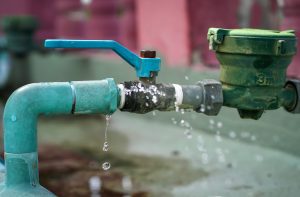
The water meter is usually found in a box in the ground out by the street, or somewhere on the edge of the property. The meter is very important because it marks the boundary between the city’s responsibility, and the homeowner’s responsibility. Everything on the street side of the meter is the city’s responsibility to maintain and repair as necessary, and everything on the home side of the meter belongs to the homeowner.
The meter is how the utility measures your water usage, but it also has a useful side benefit for a homeowner; it allows you to check for leaks on the whole water piping system. How do you do this? Just make sure that all fixtures are off in the home, and there is no water being used. Then go to the meter, and check if the numbers are changing. Depending on the age of the meter, this might be a little dial that spins, or a digital readout that changes as water is used. If the meter is not showing any change, then congratulations! You don’t have any water leaks. If it is changing or moving, than you will want to have a plumber evaluate to find and repair that leak.
A meter is supposed to have two shutoff valves, one on each side. The valve on the street side is owned by the utility and should not be touched by the homeowner. The valve on the home side of the meter is the valve for the customer’s use. We often find that these valves are broken or non-functional, or there was never one installed in the first place. You should definitely make sure you have a customer shut-off valve and that it is operational, because if your home was to have a catastrophic leak, this valve is how you would turn off the water to the home to stop the damage. If you don’t have one of these valves, Precision Plumbing is available to install one for you.
The water service
The water service is a pipe that runs underground from the water meter to the home. This pipe is usually ¾” or 1” in diameter, and carries the entire water supply to the house. These pipes are required to be 2’ deep in our area to prevent freezing. This pipe is a common spot for leaks, and when the meter is spinning but there is no water visible anywhere, usually the cause is a leak on the water service underground. Water may pool on the surface in this case, but often it just dissipates into the soil and there is no visible sign of a leak. If there’s no sign of water, usually locating the leak will require advanced leak detection equipment that can sense the sound of the leak underground, or sense a tracer gas that is injected into the pipe.
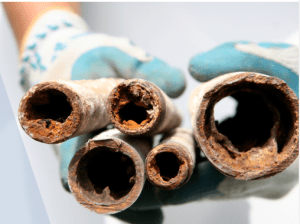
The main reason we see so many leaks on water services is that a lot of these pipes are very old and many of them were run in galvanized steel. Steel pipe buried underground in a wet climate like Oregon will rust, and eventually will rust through. The corrosion on the outside of the pipe also makes it impossible to repair these leaks on galvanized steel pipes, at least in a way that will last. When galvanized steel water services start to leak, they need to be replaced with new modern water services. At Precision, we have ways to install new water lines without digging up your yard (boring/trenchless pipe replacement).
Pressure reducing valve
When the city water pressure is above 80 PSI, the pressure must be reduced down to a safe level for the home. Pressure above 80 PSI can shorten the life of valves, fittings, and fixtures, and make leaks much more likely. Over time, the pressure supplied by the city has risen, and a lot of homes should have pressure reducing valves but don’t. This is because as more houses are built, the old water mains no longer have the capacity to supply enough water for the increased demand. Instead of tearing up the streets to increase the pipe sizing, the utilities choose to increase the pressure so the old pipes can carry more water. However, this can lead to unsafe pressures in the homes on those mains. A pressure reducing valve takes care of this problem.
The pressure reducing valve is usually either in a box in the ground just outside of the meter box, or is in the home’s crawlspace right where the water service enters the home. Every homeowner should know if they have a pressure reducing valve and where it is located, for two reasons. One, it’s important to make sure the building’s pressure is not too high to prevent expensive and unnecessary repairs. Two, pressure reducing valves are a common cause of low or no water pressure when they fail, and if a customer is complaining of sudden low water pressure, this is the first place we want to check.
The water piping system
The water piping system brings fresh water to the home and to all the fixtures. This system is very different from the waste or drainage system because it is pressurized. The utility pressurizes the water to bring it to the home, and maintains a constant pressure so there is always water there when you open a tap. However, this means that if there is a leak on the water system, the water will never stop coming out until you shut off the supply. And as plumbers, we know that a LOT of water can come out of a small pipe in a very short amount of time. If there is a leak on the water system, it will show up at the meter by the meter spinning even when no fixtures are being used.
The two main issues that can affect the water piping system are leaks, and low pressure. Leaks are caused when pipes and fittings wear out, corrode, or break. As mentioned above, these water leaks can cause a lot of damage and expense to a homeowner. Leaks should always be fixed right away; they don’t get better on their own! In our area, low pressure is usually caused by galvanized steel water piping. This pipe material rusts on the inside and all that rust and scale flakes off and clogs fixtures. The fixtures can be cleared out to improve the pressure, but the issue will keep returning until the old steel piping is replaced with new materials. If you have galvanized water piping in your home, you should be planning for a repipe sooner rather than later.
The waste piping system
The waste piping system carries used or contaminated water away from the fixtures, to the building sewer, and from there to the city sewer and treatment plant. Unlike the water piping system that works by being pressurized, the waste piping system works via gravity. All waste pipes are sloped downwards away from the fixture and away from the house, so wastewater runs through them naturally. Where the water pipes are always full of pressurized water, the waste pipes are usually empty, except for when water is run down the drain. This means that leaks on waste pipes will only show up when the fixture is being used. While water pipes leak continuously, waste pipes will have intermittent leaks that come and go.
It is important to know what materials your waste piping system is made from and approximately how old it is. A lot of older piping materials that were installed 50, 60, or 80 years ago are nearing the end of their life span. Galvanized steel drain pipes are the worst problem pipe, tending to rust and corrode until they leak sewage into the home or cause repeated clogs. But cast iron drain lines can also be problematic. As a homeowner, if you have these older pipe materials, unfortunately we are at the point in these materials’ lifespan where you will need to plan for replacement. Replacement of these older pipes is known as a “repipe”, and many homeowners are getting these done in Eugene and Springfield currently.
The sewer line
All the waste pipes in the home tie together into one larger pipe, typically 4” in diameter, that runs underground from the home to the city sewer.
Just like the water service, this pipe is the homeowner’s responsibility up to the edge of the private property. It is easy to forget about the sewer pipe since it isn’t visible, but it is one of the most important components of a home and can be one of the most expensive things to replace when it fails. Anyone who has had a failed sewer line with sewage backing up into the home can agree that the sewer line is very important!
Problems with the sewer line are indicated by sewage backups affecting multiple fixtures in the home. If a sewer line clogs once, it could be inappropriate materials being flushed down the drain, like “flushable” wipes (please do not flush these), grease, paper towels, sanitary napkins etc. However, if the sewer line clogs repeatedly, this almost always means there is something wrong with the pipe. This could be root intrusions blocking the pipe, a break in the pipe, a “belly” (area where the pipe is not properly sloped downhill), or a separation at a fitting.
There are many ways to repair and replace sewer lines, both traditionally, through open trenching and excavation, and through trenchless techniques such as pipe lining, pipe bursting, and boring. Precision Plumbing offers both trenchless and traditional sewer repairs and replacements. If you have repeated clogs, we would recommend a sewer camera inspection to figure out the issue and resolve it before it gets worse.
One of the most important things for a homeowner to know is if the home has a sewer cleanout and where it is located. This is usually found in the ground just outside the home, and is a 4” pipe extended to the surface with a threaded plug in it. The cleanout is an access point that allows plumbers and drain cleaners to access, clean, and inspect the sewer line. In case of a sewer backup, these cleanouts are extremely important, and you don’t want to be searching for the cleanout or realizing you don’t have one when sewage is flooding into your home.
The water heater
Every home has a water heater. The hot water pipes start at the heater and branch out to all of the hot outlets in the home. Water heaters can be differentiated by their fuel (natural gas, propane, electric, solar) and by their design (tank style vs. tankless.)
Tank style water heaters heat the water in a tank, keeping it warm at all times. When a tap is opened, it draws hot water out of the tank and the heater kicks on to replace that water.
Tankless water heaters don’t start heating water until a tap is opened. When they sense water flow, they immediately start heating. Due to their design, they can heat water very quickly, which is why they’re also known as “instantaneous” water heaters. These heaters have the advantage that they will never run out of hot water; they can keep heating water indefinitely.
The biggest problems water heaters have is when they stop working; for us this is the common “no hot water” call. This can happen for many reasons, and each type of heater has different components that can fail. We will do a separate blog post going into more detail about the types of heaters and their components.
The second problem that commonly affects water heaters is leaks. Tank style water heaters in particular are responsible for some very destructive leaks. This is because every tank style water heater will eventually rust through. In fact, this is how you know that a tank style heater needs to be replaced; until the tank rusts through and starts leaking, every other component can be replaced to keep that unit functioning. This is why tank style heaters are required to be installed in a drain pan that drains to the outside, unless they are in a garage or some similar area that will not cause damage if they leak.
Fixtures
Fixtures include sinks, faucets, showers, tubs, and toilets. Each of these fixtures has its own design, and there are different problems and issues that each one can have. We’ll do a separate blog post on the most common issues each of these fixtures has, and some of the causes.